
Sovereign Perspectives · Sovereign Architecture
Overcoming the AI Integration Gauntlet
Why the Answer to a Stack of Tools Is One Owned Platform

The paper
Executive Summary
In their quest to build secure AI, enterprises are assembling 'AI middleware', a recipe for failure and higher business risk.
Adopting AI is sold as buying a model. In practice it means assembling and maintaining a stack of eighteen distinct tool categories and counting, foundation models and small language models, vector and graph databases, retrieval and context engineering, orchestration and model abstraction, ontology, entity resolution and context graphs, decision traces and runtime governance, policy, identity and systems of record, capability contracts and freshness SLAs, each of which must be selected, bought, integrated, tested, deployed, and kept running. The intelligence is the easy part; the plumbing is the work, and it consumes exactly the resources most enterprises lack: scarce AI talent, capital, and irrecoverable time. Turning to a single cloud provider's full stack does not solve this; it removes the shopping list and replaces it with one deep dependency, and it compounds the problem the moment a second cloud is in play. This paper argues that the answer is not a better tool or a faster integration, but one owned sovereign platform that arrives already whole.
In Brief
- Buying AI is not buying a model; it is assembling and maintaining eighteen or more disjoint tool categories, and counting.
- The scarce resources this demands, specialized talent, capital, and time, are precisely what most enterprises do not have.
- The whole approach rests on an untested assumption, that many tools on many roadmaps will interoperate and keep working, which is rarely true and never durable.
- A single cloud provider's full stack keeps the sprawl, now one vendor deep, with lock-in by design, uncapped pricing, and a stack to reassemble for every additional cloud.
- Agentic AI multiplies the tools and the calls, and multi-cloud multiplies the whole stack, so cost, fragility, and risk compound together.
- It all still runs on public models, so the IP and data exposure these tools were bought to prevent simply stays; one owned platform removes the gauntlet and the exposure at once.
Every tool added increases cost, fragility, and risk exposure. Assembling more middleware moves an enterprise further from secure AI, not closer.
1. The AI Middleware Sprawl
An enterprise that sets out to build secure AI quickly discovers that the model is the least of its problems.
Around the model sits a sprawl of separate components, each necessary, none sufficient, and none designed to work with the others. Since 2020 the list has grown to eighteen tool categories and counting, and it reads like an infrastructure project rather than a product: foundation models and small language models, vector and graph databases, retrieval and context engineering, orchestration and model abstraction, ontology and validation, entity and master-data resolution, context graphs, decision traces, runtime governance, policy and identity, systems of record, capability contracts, and freshness SLAs. Every one is drawn from a different vendor, on its own release cycle, with its own interface, its own failure modes, and its own bill, and every one must be selected against alternatives, integrated with the rest, tested end to end, deployed, and then maintained forever, because none of them stops changing.
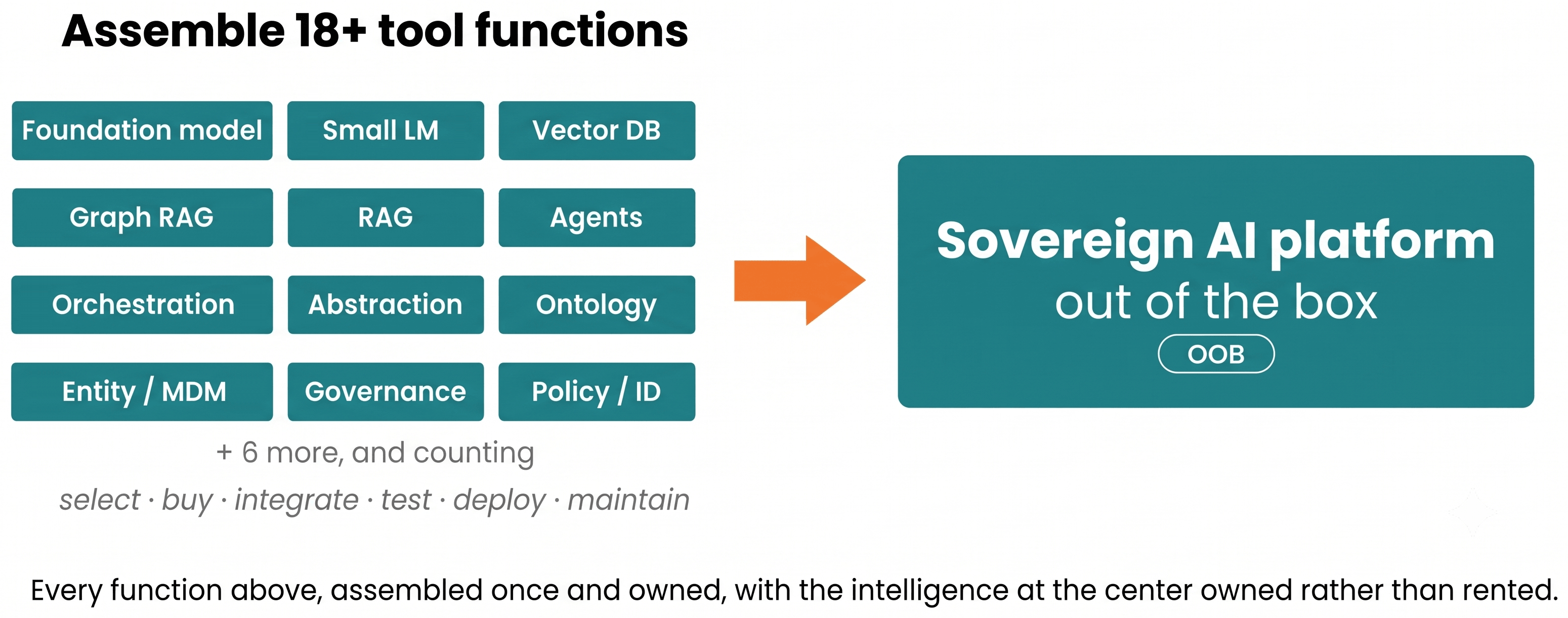
The people who can hold all of this together, who understand the model and the retrieval layer and the orchestration and the governance and the security posture at once, are among the rarest and most expensive in the market. The scale of the challenge hides behind the headline of adoption: organizations using AI rose from 55 percent to 78 percent in a single year, which reads as triumph until one asks how much of it turned into value. Adoption measures how many companies entered the gauntlet. It says nothing about how many made it through.
18 and counting The stack a buyer must assemble is not shrinking as the field matures. It is growing, one indispensable new tool at a time.
2. Why the Gauntlet Exists
The gauntlet is not an accident of an immature market. It is the shape the market chose, because it is the shape that is easiest to sell, and it assumes a buyer most enterprises are not.
The approach is built for the few. Assembling AI middleware assumes deep in-house AI talent, the kind required to select, wire, and operate a dozen and a half specialized tools, and most enterprises lack that talent for ordinary cloud adoption, let alone for agentic AI. It also assumes time the enterprise does not have. The build-and-experiment model needs runway, and on the AI clock every quarter spent integrating tools is ground lost to competitors who are shipping value or who bought a platform and skipped the assembly entirely. The market produces this outcome because point tools are simpler to build, price, and sell than an integrated whole, and the hardest, least glamorous part, the integration, is the one thing no vendor sells, so it falls by default to the buyer.
The result is that the enterprise becomes the systems integrator of last resort for a stack it never wanted to assemble, staffed by talent it cannot spare, on a clock it cannot afford, absorbing the complexity the market found more profitable to offload than to solve. The gauntlet exists because running it is the customer's problem and selling the pieces is the vendor's business.
The market sells the pieces and leaves the buyer to build the machine, on the assumption that every buyer has the talent and the time. Most have neither.
3. The Incorrect Assumption That Everything Will Work
Beneath the tool-by-tool approach lies an assumption almost no one states and almost nothing supports: that the pieces will work together, and keep working.
A stack of eighteen tools is a stack of eighteen interfaces, and every interface is a place where things can fail. The plan to assemble them assumes that each tool does what its demo promised, that each interoperates cleanly with the others, that the whole is stable in production under real load, and that it stays stable as each part is independently updated by a vendor with no obligation to the others. None of these assumptions is safe. Each third-party tool moves on its own fast roadmap, so every addition multiplies version drift, breakage, and instability; tools that work in isolation behave differently in combination; the demo that dazzled on curated data collapses on the enterprise's own; and the integration that held last month breaks when one vendor ships a new version, with the enterprise, not the vendor, owning the break.
So the gauntlet is not run once but continuously. Integration is not a phase that ends; it is a standing liability re-earned every time any component changes, which is constantly. The enterprise has built a system whose reliability depends on the coordinated behavior of many independent parties, none of whom is responsible for the whole, and it has simply assumed that coordination will happen. When it does not, and it will not, the cost lands on the buyer, in outages, in rework, and in the slow erosion of trust that follows every time the system meant to help instead breaks.
Every seam A stack of eighteen tools is eighteen things that must all keep working together, maintained by vendors who owe each other nothing and the buyer less.
4. The Single-Provider Path Is Not the Escape
The obvious escape is to buy the whole stack from one cloud provider. It removes the shopping list and keeps the sprawl, now one vendor deep.
A single cloud provider's full stack looks like an answer, because it replaces many vendors with one. But it is still a stack to assemble, wire, and govern, and it introduces failure modes of its own that are, if anything, harder to escape. It fails differently, and the differences matter.
| How the single-provider path fails | What it means for the enterprise |
|---|---|
| Lock-in by design | Integration depth becomes a hostage situation; by year three every pipeline runs on the provider's interfaces and the exit cost is prohibitive |
| The ground keeps moving | Native services are renamed, re-tiered, and deprecated on the provider's roadmap, and the enterprise absorbs the churn |
| One-way modernization | Proprietary managed services are cheap to enter and costly to leave; exiting means re-architecting what was just built |
| Uncapped pricing | Agentic pipelines burn ten to fifty times the compute of single queries, on the provider's meter, so the bill climbs with every workload |
| Single-cloud by construction | Each cloud is its own silo, so a multi-cloud estate means assembling and running the whole stack again, per cloud |
| Still your integration problem | The provider ships the parts; the wiring, governance, and day-to-day operations across them stay the enterprise's to own |
The trade is many contracts for one dependency, and the sprawl reassembled again for the next cloud. A buyer that took the single-provider path to escape the gauntlet finds it has swapped an integration problem it could at least shop around for a lock-in problem it cannot.
10-50x Agentic pipelines burn ten to fifty times the compute of a single query, on the provider's uncapped meter, and the bill rises with every workload.
5. What Worsens: Agentic AI and Multi-Cloud
The gauntlet was always described as an application problem, so many tools per application, but agents change its arithmetic. Every agent is itself a consumer of the whole stack, invoking models, retrieval, orchestration, and governance on its own, so the assembly no longer scales with applications but with agents, which grow far faster. An estate that could just about hold eighteen tools together for two hundred applications cannot hold them together for a thousand agents each exercising all of them. Agentic sprawl is what turns an unmanageable assembly into an ungovernable one.
Two forces are turning a difficult assembly into an unmanageable one: the rise of agents, and the reality of multiple clouds.
Agentic AI multiplies every dimension of the gauntlet at once. An agent that plans, retrieves, calls tools, checks its work, and hands off to other agents does not touch one tool; it touches most of them, many times per task, so the number of integrations that must hold, the number of calls that must succeed, and the volume of compute consumed all rise by an order of magnitude. Every seam that could fail is now crossed dozens of times per workflow, and every uncapped meter now runs continuously. The fragile assembly that was merely expensive as a chatbot becomes a standing operational risk as an agent swarm.
Multi-cloud multiplies the other way. Because each cloud is its own silo, a genuinely multi-cloud estate means assembling and running the entire stack again, per cloud, with a second set of integrations, a second dependency, and a second uncapped meter, none of which interoperates with the first. The enterprise that adopted AI to move faster finds itself maintaining two or three parallel gauntlets, each fragile, each locked in, each billing separately, and each its own to keep running. Cost, fragility, and consumption do not add across these forces; they multiply.
Multiplied Agents multiply the calls and the failure points; multi-cloud multiplies the whole stack. The gauntlet does not lengthen, it compounds.
6. The Risk They Were Meant to Remove
Here is the paradox at the center of it all. The middleware was assembled to make AI secure, and it leaves the core exposure exactly where it was.
Whichever path an enterprise takes, the assembled stack and the single-provider stack alike, it all still runs on public models. The guardrails, the governance tools, the policy layers, all of the middleware bought to contain the risk, sit around an intelligence the enterprise does not own and does not control, and through which its data and prompts still pass. The IP and data exposure these tools were purchased to prevent simply stays. The enterprise has spent heavily, added complexity, and increased fragility, all in the name of secure AI, and the one risk it most wanted to remove remains untouched, because it lives in the model at the center that none of the middleware replaces.
The middleware was bought to remove the risk. It runs on public models, so the risk stays, and the cost, fragility, and exposure are all that was added.
7. The Sovereign AI Platform Alternative
The answer to a stack of eighteen rented tools is not a nineteenth, and it is not one vendor's version of the same stack. It is to stop assembling and start owning.
One owned, sovereign platform that brings the model, the grounding, the orchestration, the governance, and the connectors together, out of the box and ready to use, does not help a buyer run the gauntlet faster; it removes the gauntlet. The integration is done once, by the platform, rather than repeatedly and imperfectly by every buyer. The assumption that the pieces work together is discharged by the party that built them together and is responsible for the whole. The intelligence at the center is owned rather than rented, so the data and IP the middleware could not protect never leave. And because the platform is not tied to one cloud, a multi-cloud estate does not mean a second gauntlet.
| Dimension | The two rented paths | One owned platform |
|---|---|---|
| Integration | Wire eighteen-plus tools, or one vendor's stack you still assemble | Integrated once, and owned |
| Lock-in | Many contracts, or one deep dependency | Portable, and yours |
| Pricing | A consumption meter under everything | A fixed, owned cost |
| Multi-cloud | Reassemble the whole stack per cloud | One platform across clouds |
| IP and data | Runs on public models; the exposure stays | No egress by design; data never leaves |
| Day-2 operations | Yours to run | The platform's to run |
A platform is not a bigger stack. It is the decision to buy the integration already done, to own the intelligence at its center, and to make one party responsible for the whole.
8. What Leaders Must Do
- Count the whole cost, not the tool. Price AI adoption by the integration, the talent, the time, and the maintenance it demands, not by any single model's sticker.
- Refuse the assumption of seamless interoperation. Do not build a strategy that depends on many independent vendors coordinating on your behalf; make one party responsible for the whole.
- See the single-provider path for what it is. Recognize that one vendor's full stack trades many contracts for one dependency, keeps the meter, and reassembles for every additional cloud.
- Plan for agents and multiple clouds. Assume the calls, the integrations, and the compute will multiply, and choose an approach that does not multiply the gauntlet with them.
- Own the intelligence at the center. Adopt one sovereign platform, so the integration is done, the data never leaves, and the risk the middleware could not remove is finally gone.
One platform The enterprise that owns one integrated platform spends its scarce time and talent on its business, not on plumbing that may not hold and does not make it secure.
9. The Reframe
The story the market tells is that adopting AI means choosing the best model. The reality is that it means signing up to integrate, and to keep integrating, a stack no one else will, on public models that leave the core risk in place.
That is the integration gauntlet, and it is why adoption has outrun value and why secure AI stays out of reach. Its costs, the scarce talent, the irrecoverable time, the fragile seams, the lock-in, and the exposure that never leaves, all compound as agents multiply the calls and every new cloud reassembles the stack. The way through is not a faster integration or a better tool, and it is not one vendor's version of the same sprawl. It is to stop assembling altogether, and to own one sovereign platform that arrives already whole, so the enterprise can spend its scarce talent and its irreplaceable time on the business it is actually in, with the intelligence, the data, and the risk finally under its own control.
The category The answer to a stack of eighteen rented tools is not a nineteenth, and not one vendor's stack. It is one owned platform, and the decision to stop assembling.
About this series
Sovereign Perspectives
Sovereign Perspectives is a research program on the ownership and governance of intelligence, published by Concierto. Its papers examine the strategic, economic, and institutional questions that artificial intelligence raises for governments and other accountable institutions, and they are written for the leaders making those decisions. The program's aim is to advance the public argument, not to promote a product.
- Stanford Institute for Human-Centered AI (HAI), 2025 AI Index Report. Business-adoption data. hai.stanford.edu. The composition of the AI middleware stack, the single-provider failure modes, and agentic compute multiples are described from the observed structure of enterprise AI deployments.

Start your FREE C/AI Trial
Deploy Sovereign Spark in your own cloud account in days. Your team gets C/Composer and C/Code inside your VPC, with nothing leaving your walls.
Forward this to your CIO and ask them to compare how long our current AI path will take to deliver against a days-not-years deployment.